How to Edit an AI-Assisted Draft So It Still Sounds Like You
Edit an AI-assisted draft in three passes: argument and order, then sentence rhythm, then words. The rhythm pass is the one most writers skip, and it is where your voice comes back.
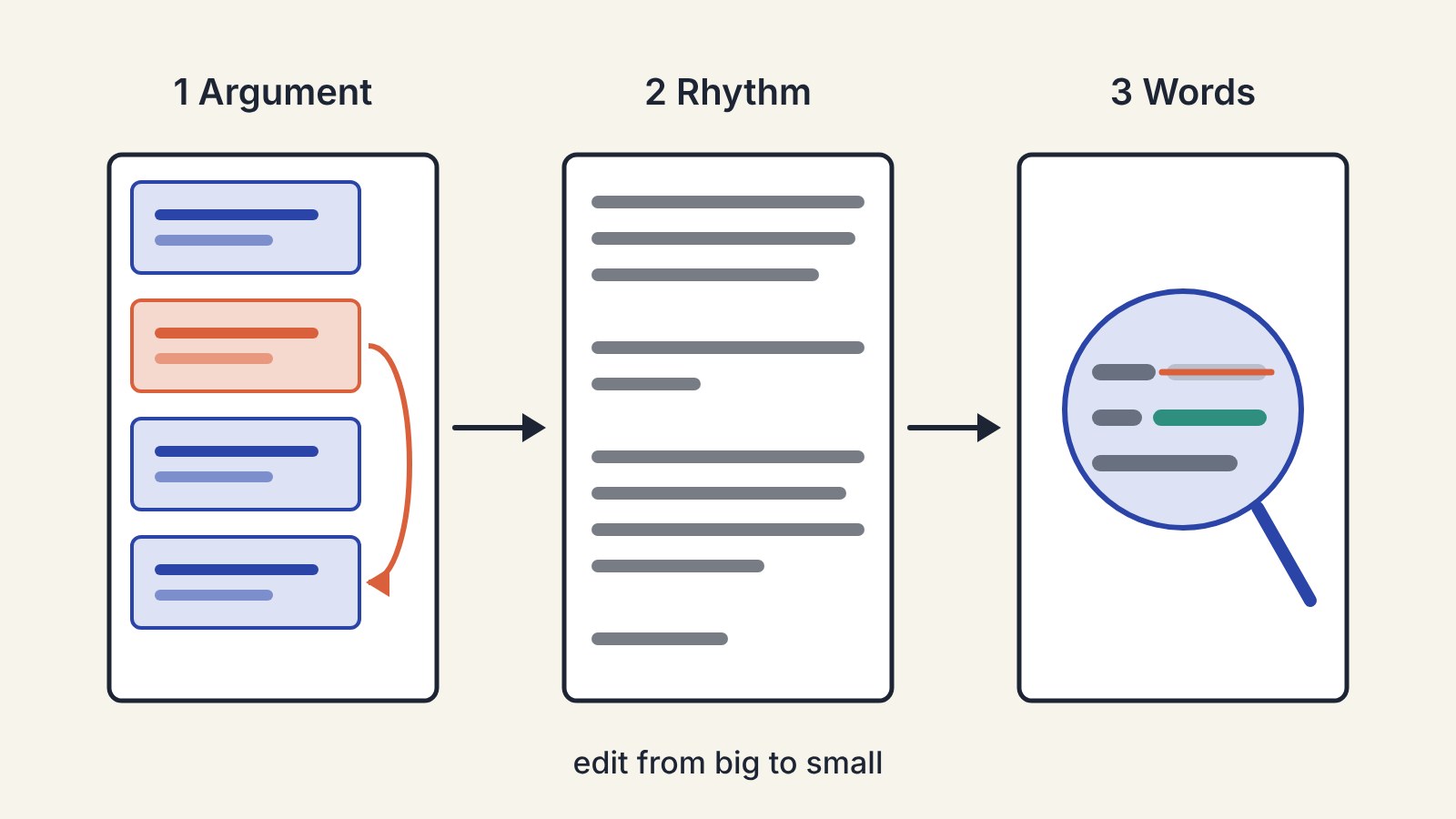
To make an AI-assisted draft sound like you, edit it in three passes, from big to small: first the argument and order, then the rhythm of the sentences, then the individual words. Most people jump straight to swapping words, and the draft still reads like a machine wrote it, because the giveaway is rarely a single word. It is the evenness.
Assistants write in a steady, safe register. Paragraphs come out the same length. Sentences follow the same pattern. Every point gets the same weight, every section ends with a neat line, and nothing is said more strongly than it needs to be. Readers feel that sameness even when they cannot name it. Your edit has to break it.
Before you start: know what your voice is
You cannot restore a voice you have never described. Pull up two or three pieces you wrote without help and that you are happy with. Read them for a few minutes and note what you do:
- How long are your paragraphs? Do you ever write one-line paragraphs?
- Do you use "I"? Do you address the reader as "you"?
- How do you open: with a scene, a claim, a question you then answer?
- What words do you use that most people do not, and which common words do you never use?
- How strongly do you state opinions?
Keep the list next to the draft. It is the standard you are editing towards, and it stops you from editing towards a vague sense of "better".
Pass 1: the argument and the order
Read the whole draft once without touching a sentence. Ask:
- Does it make the point you meant to make? Assistants drift towards the most common take on a topic. If your angle was sharper, the draft has probably sanded it down.
- Is anything here that you would not say? Delete it, even if it is well written.
- Is your best example in it? If the draft uses a generic example where you have a real one, swap it in. Specific detail from your own work is the single strongest marker of a human writer.
- Is the order yours? Move sections until the piece builds the way you would explain it out loud.
If the draft started from an outline you built yourself, this pass is quicker. Outlining with an AI assistant while keeping your own angle covers how to set that up.
Pass 2: the rhythm
This is the pass that does the most work and gets skipped most often. Read the draft aloud, or at least under your breath. Your ear will catch the evenness that your eye glides over.
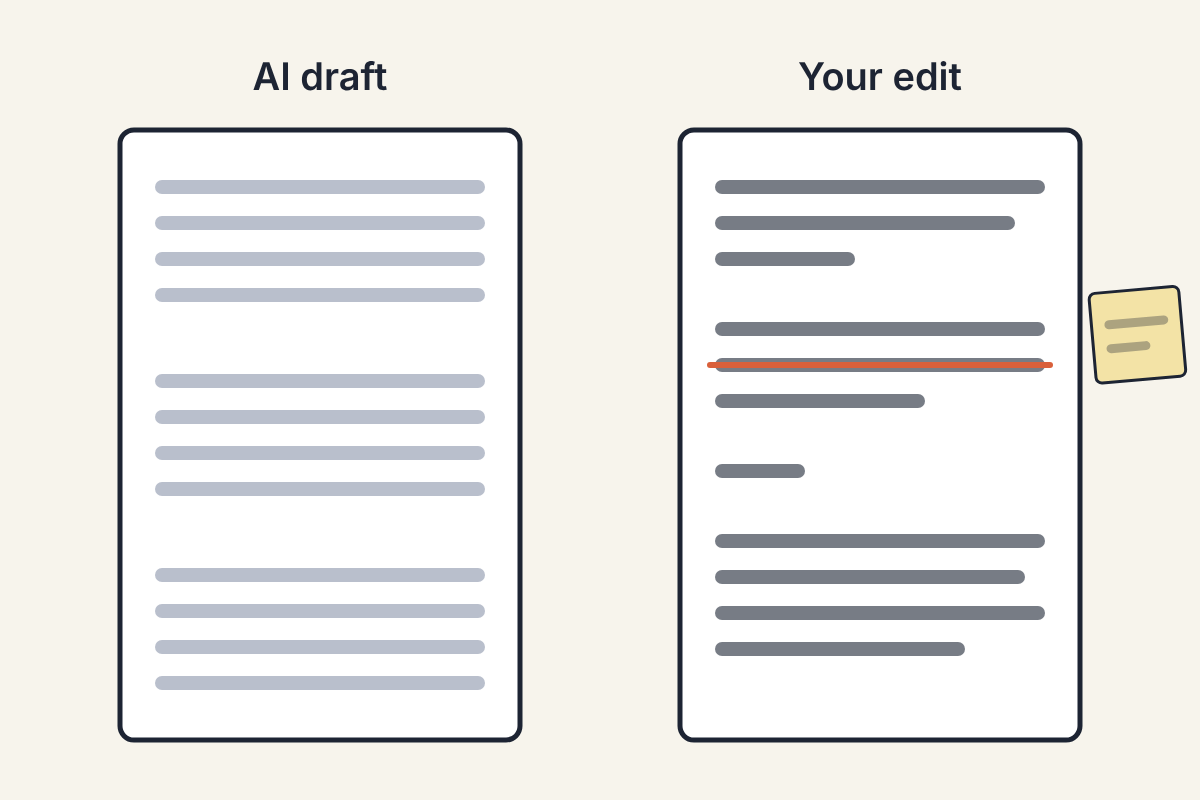
Then change the shape:
- Vary sentence length on purpose. After two long sentences, write a short one. Let a long one run when the thought needs room.
- Vary paragraph length. Split a paragraph where the thought turns. Give your strongest point a paragraph of its own.
- Cut the tidy endings. Assistants like to close each paragraph or section with a line that restates it. Delete those lines and see if anything is lost. Usually nothing is.
- Break the lists of three. Drafts love three adjectives, three examples, three benefits. If you only have two good ones, use two.
- Commit. Where the draft hedges ("this can often help in some cases"), decide what you think and say it. If you are not sure, say what you are not sure about.
Pass 3: the words
Now go line by line. Replace anything you would not say in conversation. Some patterns to hunt for:
- Stock phrases that sound like writing rather than speech: grand claims about something's "role", openings about the modern world, announcements that a point is worth noting. Ask what the sentence actually claims and write that.
- Sentences that set up a straw idea only to replace it with the real one. Say the real one.
- Linking words at the start of every other sentence. Most of the time the sentence works without them.
- Vague praise adjectives that could describe any product. Say what the thing does.
- Questions asked only to be answered in the next sentence.
Then add back the words from your list: your usual expressions, the way you refer to your readers, a joke if you would make one. Do this sparingly. Three of your habits in the right places do more than ten forced in.
Using the assistant to help you edit
The assistant can help with this, as long as you give it narrow jobs and keep the judgement. Prompts that work well:
- "Here are two paragraphs I wrote myself and one from a draft. List the differences in sentence length, word choice and tone."
- "Mark every sentence in this section that restates the previous one."
- "Find every hedge in this draft and quote it."
Each of these points you at spots to fix. Rewriting the spots is still your job. Asking the assistant to "make it sound more like me" usually produces a new, slightly different version of the same even register.
Check the facts before you polish
A draft that sounds exactly like you is worse than useless if one of its claims is wrong, because now the error carries your name. Before the final read, go through every fact, figure, quote and source the draft contains. Our guide to checking what an AI assistant tells you has a simple routine for it.
The last read
Finish with one read from start to end, as a reader rather than an editor. You are listening for any line that makes you wince, any stretch where you would skim, and the ending. If the last paragraph sums up what came before, cut it and end on the last thing that tells the reader something new. A piece that stops when it is done sounds confident, and confidence is a large part of what reads as a real person's voice.
