How to Check the Facts an AI Assistant Gives You Before They Reach Your Draft
Treat every fact from an AI assistant as a lead. Trace it to the original source, check the source says exactly that, then keep and cite it, rewrite it, or cut it. A five-step routine for writers.
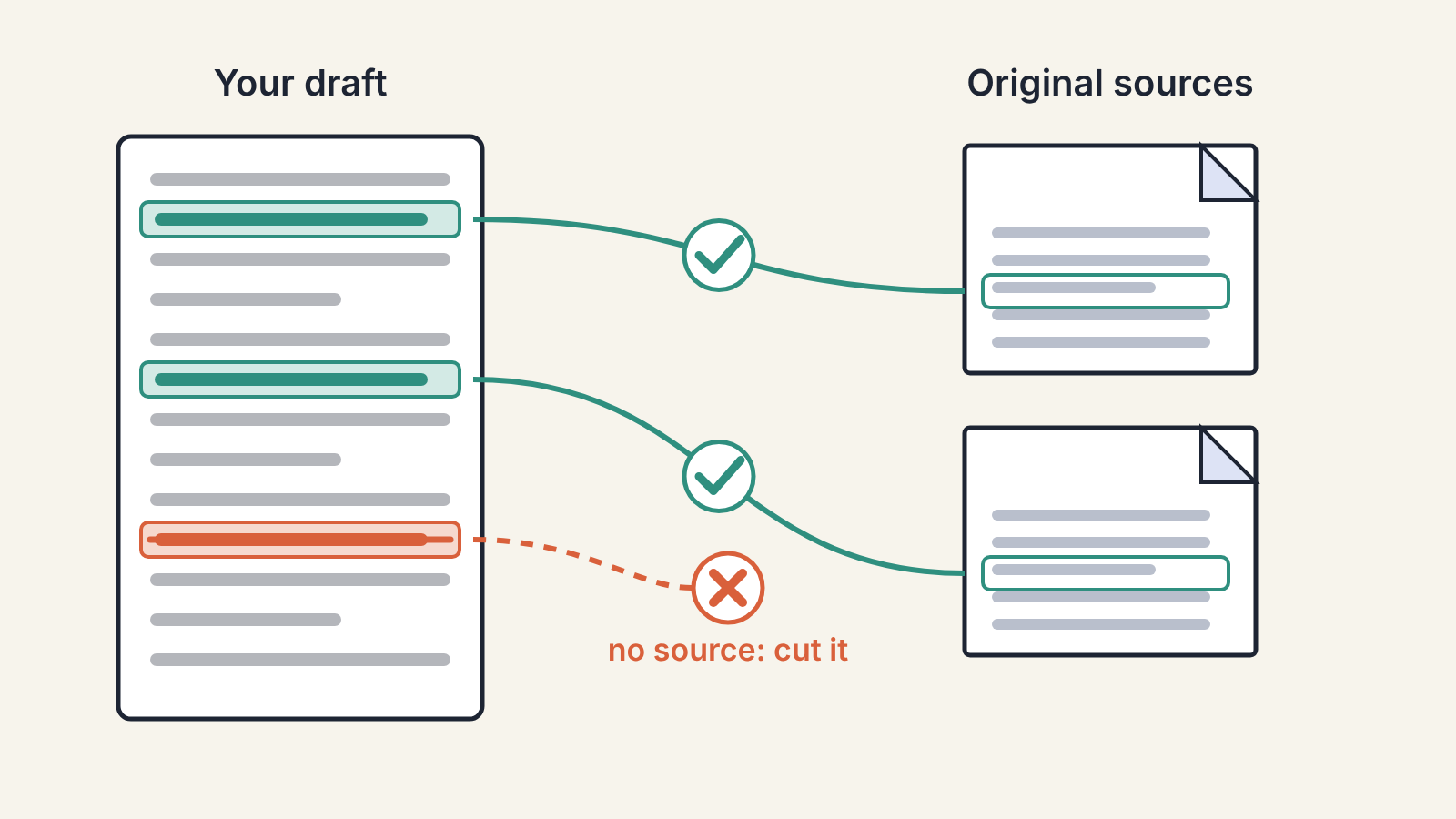
Treat every fact an AI assistant gives you as a lead, not a finding. Before it goes into your draft, trace it to an original source you can open and read, check that the source says what the assistant claims, and cite that source rather than the assistant. If you cannot find one, cut the claim or rewrite the sentence so it does not need it.
That sounds slow. In practice it is a short routine, and it saves you from the one mistake that hurts a writer most: publishing something confidently wrong under your own name.
Why assistants get facts wrong
A language model writes the most plausible next words. Most of the time plausible and true line up. Sometimes they do not, and the model has no internal signal telling it which case it is in, so a wrong answer arrives in the same calm, fluent tone as a right one. The errors cluster in predictable places:
- Exact numbers: percentages, dates, prices, counts.
- Quotes, especially neat ones attributed to famous people.
- Citations: paper titles, authors, journal names and links that look right and do not exist, or exist and say something else.
- Recent events that happened after the model's training data was collected.
- Niche details where little was written down in the first place.
Assistants that search the web and show links are more useful here, because they hand you a starting point. They still summarise sources imperfectly, so a link next to a claim does not mean the page supports it. You still have to open it.
Step 1: Pull every checkable claim out of the draft
Go through the draft, or the assistant's research notes, and copy every claim that could be true or false into a list. A claim is anything a reader might repeat to someone else: a number, a date, a name, a "studies show", a quote, a statement about what a product or law does.
Opinions and advice do not go on the list. "Write your angle before you outline" is a recommendation, and you are responsible for it as the writer. "Most professional writers outline first" is a fact claim and needs a source.
Step 2: Find the original source for each one
For each claim, look for the place it comes from, not a page that repeats it. That usually means:
- For a statistic: the organisation that collected the data, and its own report or table.
- For a quote: a recording, a transcript, or the book or article where the person said it, with enough context to see what they meant.
- For a study: the paper itself, or at least its abstract on the journal's site.
- For a product feature or policy: the maker's or agency's own current page.
You can ask the assistant where a claim comes from, and that is often a good shortcut. Then open what it names. If the paper, page or person it points to does not turn up, treat the claim as unsupported.
Step 3: Read what the source actually says
This is the step people skip. Finding a real source is half the job; the other half is checking that it supports the exact sentence you want to write. Common gaps:
- The number is real but from a different year, country or group.
- The study found a link, and the draft says one thing causes the other.
- The quote is real but shortened so it means something different.
- The source is itself repeating someone else, and you need to go one step further back.
Adjust your sentence to match the source, not the other way round.
Step 4: Keep it, fix it or cut it
Each claim ends up in one of three places:
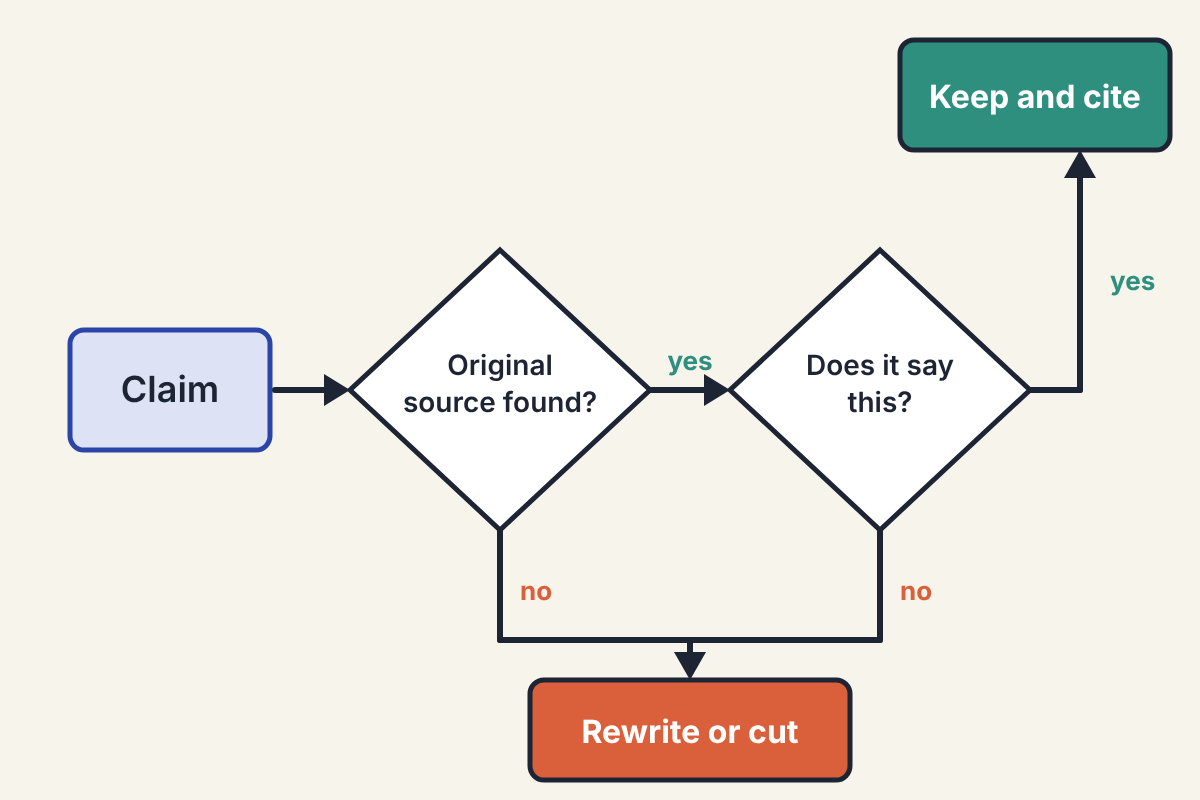
- Keep and cite when you found the original and it says what you wrote. Link to it, or name it in the text.
- Fix when the source supports a narrower or different claim. Rewrite the sentence to say exactly that.
- Cut when you cannot find a source you trust. Often the sentence works without the number: "many readers skim" makes the point as well as an unverified percentage does, and it is honest.
Cutting feels like a loss. It rarely is. Readers forgive a piece for being less precise far more readily than for being wrong.
Step 5: Cite the source, never the assistant
"According to an AI assistant" is not a source. The assistant was a search aid, and it does not stand behind its answers. Your readers need something they can check themselves, so the citation points to the original you read. If your publication has a style for citations, use it; if not, a descriptive link in the sentence is enough.
Make it a habit, not a chore
A few habits keep this routine short:
- Ask for sources up front. When you use an assistant for research, ask it to name where each point comes from, and to say when it is unsure. You will still check, but you will know where to start.
- Keep a running source list while you research, with the link and the line that supports each claim. A notes app that saves the source with each clip makes this close to automatic, and at the end the citations are already done.
- Check before you polish. Rewriting a paragraph for voice and then cutting its key fact wastes the edit. Our guide to editing an AI-assisted draft so it sounds like you puts this check before the final read for that reason.
- Mark gaps while outlining. When you plan a piece, note which sections need facts you do not yet have, as described in outlining an article with an AI assistant. Then research those on purpose instead of letting the assistant fill them.
The assistant is fast at suggesting what might be true and where to look. Deciding what is true, and putting your name to it, stays with you.
