How to Write a Thanksgiving Toast or Thank-You Note That Sounds Like You
The toasts people remember are about a minute long and built on one real thing someone did. Here is how to find that thing, shape it, draft it with or without an AI assistant, and rehearse it so it sounds like you talking.
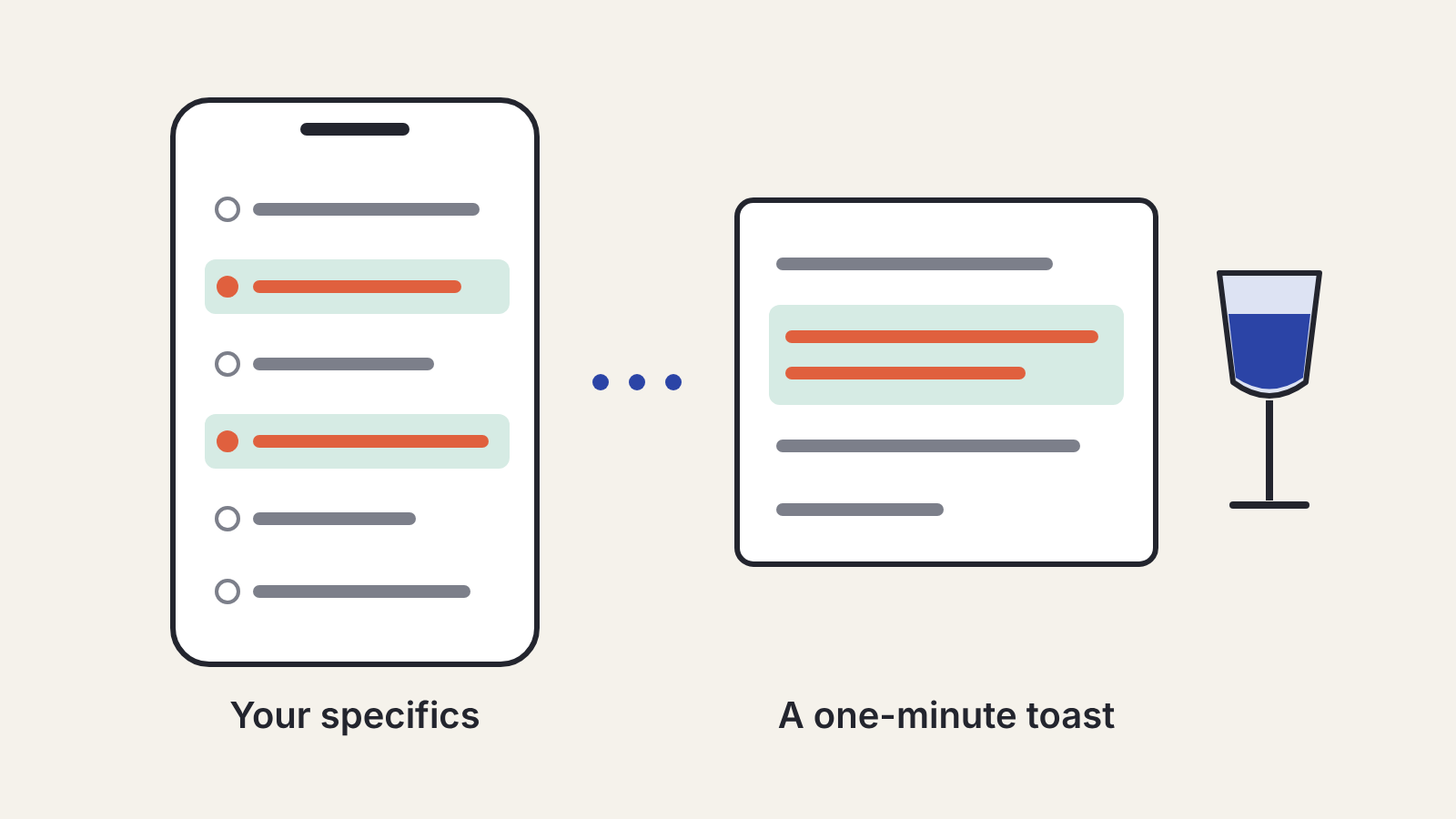
A good Thanksgiving toast or thank-you note is short, names one or two real things a specific person did, and sounds like you talking. Gather those specifics first, fit them into a simple four-part shape, draft (on your own or with an AI assistant), then cut it down and read it aloud until it runs about a minute. The specifics do almost all the work. Everything else is trimming.
This guide walks through that workflow step by step, with example lines you can borrow the shape of. It works the same whether you are raising a glass at the table on Thursday, November 26, or writing a note to the friend who hosted you.
Step 1: Gather your specifics before you write a word
Generic gratitude is the reason most toasts blur together. "I'm thankful for family, friends and good food" is true for everyone in the room, so it lands on no one. The fix is raw material, and you collect it before drafting.
Open a note on your phone and spend ten minutes answering these:
- Who is this for? One person, a couple, the whole table, a host?
- What did they actually do this year? Drove you to the airport at 5am, fixed the gutter, took the kids for a weekend, sent soup when you were ill.
- What is one moment you remember? A small scene beats a summary. The night the power went out and everyone played cards by torchlight is worth more than "we had some tough times".
- What is a word or habit that is theirs? The way your aunt says "right then" before every meal. The spreadsheet your brother keeps for the pie order.
- What do you want them to feel when you finish? Seen, thanked, laughing, all three?
You will not use everything. That is the point. A list of eight specifics gives you two or three good ones to choose from, and choosing is where the toast starts to sound like yours.
Step 2: Use a simple four-part structure
Most short toasts and notes follow the same shape, and readers and listeners find it easy to follow:
- Open with why you are speaking or writing. One line.
- Name the specific thing. The moment, the favour, the habit.
- Say what it meant. What changed for you because of it.
- Close with a wish or a raised glass.
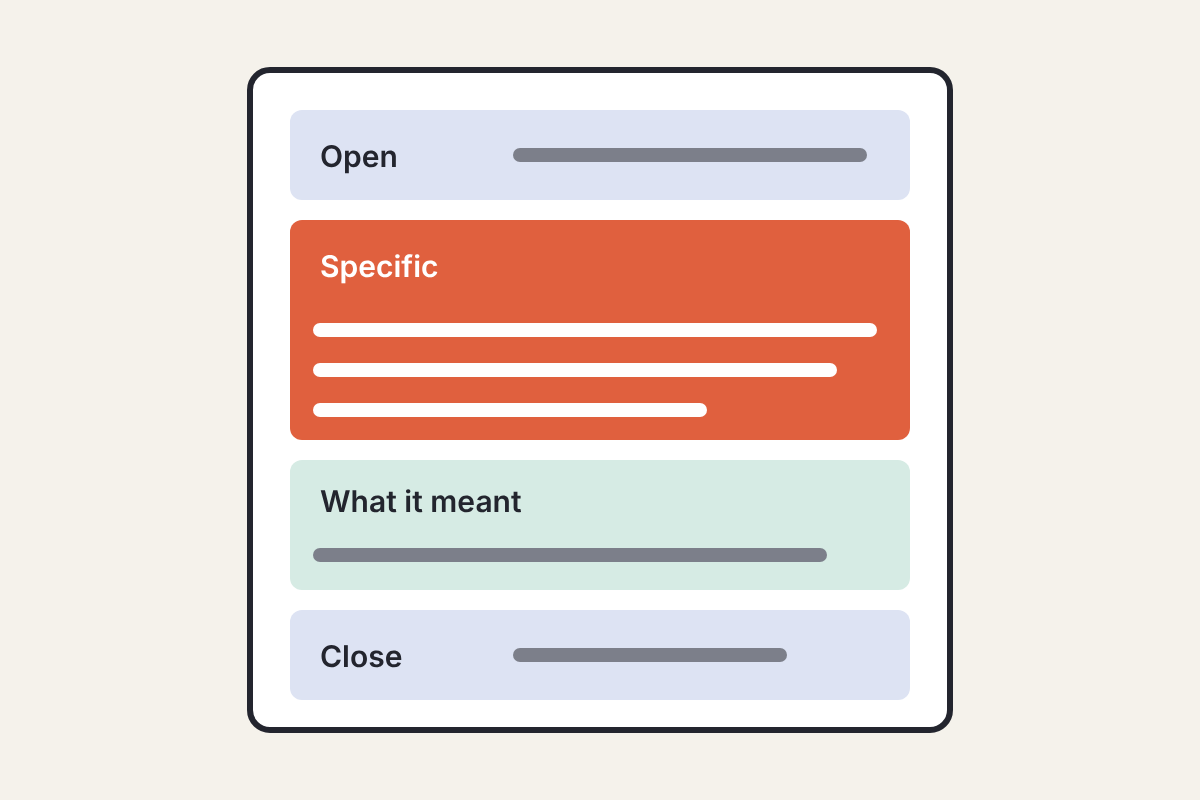
Here is that shape as a toast, written for an imaginary host:
I just want to say a quick thank you to Maya before we eat. In March, when our kitchen flooded, she told us to "bring the pans" and we cooked at her place for three weeks. I don't think we ever said properly how much that kept us sane. So, to Maya, and to never needing to borrow her oven again.
And as a note to a neighbour:
Dear Tom, thank you for keeping an eye on the house in August. Coming back to find the bins in and the tomatoes watered was the nicest welcome home we've had. We owe you a pie this week. Warmly, Priya
Neither example says "grateful" more than once. Neither tries to cover the whole year. Each one picks a single real thing and lets it carry the message.
Step 3: Decide the length before you draft
Length is a decision, not an accident. Make it up front so you write to fit.
For a toast, aim for something you can say in about a minute. People are hungry and the gravy is cooling. If you have more to say, that is a sign you need a note or a conversation later, not a longer speech. Keep it to one or two specifics.
For a handwritten card, three to five sentences usually fill the inside comfortably. Write it out in full on scrap paper or your phone first, so you are not editing in ink.
For an email or message, you have more room, but a thank-you that scrolls loses force. Keep it to a short paragraph or two.
Whatever the format, decide one thing you will not include. If the year had five good moments, pick one for the toast and save the rest for when you see people one to one.
Step 4: Draft it, by yourself or with an AI assistant
If you already have your specifics, try writing the first draft yourself. With a clear structure and real material, a four-sentence toast often comes out in a few minutes, and it will sound like you because it came from you.
If you are stuck, an AI assistant can help, as long as you give it your material and narrow the job. The prompt that produces a greeting-card toast is "Write a Thanksgiving toast for my family." The assistant has nothing to work with, so it fills the gaps with the most common phrases it knows.
A prompt that gives you something usable looks more like this:
I'm giving a one-minute Thanksgiving toast to about twelve people, mostly family. I want to thank my sister Ana, who drove four hours each way twice this autumn to help after Dad's surgery. One detail: she brought her own coffee maker because she says ours "doesn't count". Tone: warm, a little funny, not sentimental. Write three short versions, each under 100 words. Use my details, don't add any new facts, and avoid clichés about gratitude and blessings.
That prompt works because it sets the audience, the length, the one person being thanked, a real detail and the tone, and it tells the assistant not to invent anything. Asking for three versions gives you options to mix, instead of one draft to accept or reject.
Treat what comes back as raw material. Take the best line from one version and the best ending from another, and rewrite the rest in your own words.
Step 5: Edit until it sounds like you
AI drafts of short, emotional pieces have a recognisable sound: every sentence balanced, a little too polished, ending on a neat moral. Here is what to look for when you edit, whether the draft came from you or an assistant:
- Swap any generic phrase for a specific one. "Your endless support" becomes "the four-hour drive, twice".
- Cut anything you would never say aloud. If you would not use the word "cherish" at the dinner table, do not put it in your toast.
- Check every fact. Assistants sometimes add details to round out a story. If it says your sister "stayed for a week" and she stayed for three days, fix it.
- Keep one of your own habits. A phrase you always use, the nickname you call someone. One is enough.
- Drop the tidy final line. If the last sentence restates the toast as a lesson, end on the raised glass instead.
Our longer guide on editing an AI-assisted draft so it still sounds like you covers the same passes in more depth. If you keep a personal style sheet for AI editing, paste it into your prompt too. It saves you from undoing the same habits every time.
Here is a before and after, using the sister example:
Draft: I'd like to take a moment to express my heartfelt gratitude to my wonderful sister Ana, whose unwavering support during a challenging time meant the world to our family.
Edited: Ana drove four hours each way, twice, to help with Dad this autumn. And she brought her own coffee maker, because ours "doesn't count". Ana, thank you. We'd have been lost without you, and very under-caffeinated.
The second version is a little longer, and it is far easier to listen to, because it is all detail and no padding.
Step 6: Rehearse it out loud
Reading aloud is where you find the sentence that is too long to say in one breath, the word you always trip on, and the joke that is funnier on paper than in the air. Read it to yourself two or three times, then once more while timing it on your phone.
If you are not sure how it sounds, let your device read it back. Most phones and computers have a built-in read-aloud feature, and hearing a flat, neutral voice read your words shows where the rhythm stalls. Our guide to proofreading by listening explains how to set that up.
A few things to adjust after a read-through:
- Break any sentence that makes you run out of breath.
- Move the name of the person you are thanking near the start, so the table knows who to look at.
- Make the last line short and clear, so people know when to raise their glasses.
You do not need to memorise a toast. A small card with the first words of each line is fine. For a written note, reading it aloud once before you copy it out catches the missing word and the sentence that sounds stiff.
More example lines to adapt
These are starting shapes. Replace the bracketed parts with your own specifics, then read them aloud and change anything that does not sound like you.
For a host:
Before we start, thank you to [name] for having us. [One thing they did to make today happen]. We noticed, and we're grateful.
For someone who helped this year:
[Name], I don't think I said it properly at the time, so here it is: thank you for [specific thing]. It made [specific difference].
For the whole table, kept light:
I'll keep this short because I can see [name] eyeing the potatoes. Thank you all for being here. To [one shared thing from this year].
For a thank-you note after the meal:
Dear [name], thank you for a lovely Thanksgiving. [Detail you enjoyed: a dish, a conversation, a game]. We're still talking about [specific moment]. Love, [your name]
None of these will be finished until a real detail goes in. If you cannot think of one for a particular person, that is useful to know too: it may mean a short, honest "thank you for having us" is the right note to strike, and that is better than padding it out with lines you do not mean.
